The Breakthrough: AMIE Tops Primary Care Physicians
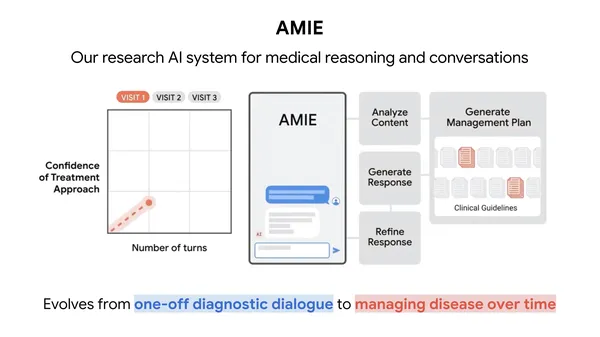
Google's conversational AI system, AMIE (Articulate Medical Intelligence Explorer), just published results in *Nature* that are hard to ignore. The system matched — and in some cases beat — primary care physicians in managing complex, multi-morbidity cases. Researchers used a simulated patient environment with standardized actors. AMIE outperformed human doctors on diagnostic accuracy and communication quality, scoring higher on 28 of 32 evaluation axes. That includes empathy, clinical reasoning, and management planning. Not bad for a machine that doesn't sleep.
Why This Matters: Medical AI's Long Road to Bedside Chat
For years, medical AI was about image recognition: read a scan, spot a tumor. But managing chronic conditions like diabetes, heart failure, or depression requires nuance — picking up on a patient's hesitancy, adjusting treatments based on lifestyle. Earlier systems couldn't handle that. They were crib sheets, not clinicians. AMIE is different. It's trained on over 10,000 patient-doctor conversations, then refined with reinforcement learning. The result? A system that doesn't just answer questions but asks them, builds rapport, and suggests differentials. That's a leap from the sterile chatbots of the past.
What This Means for Healthcare Delivery (and Your Next Visit)
Here's the thing: AI that matches doctors doesn't mean AI replaces doctors. It means AI could handle the heavy lifting of routine management — freeing up physicians for the complex, hands-on care only a human can provide. Think of it as a supercharged triage nurse that never forgets a guideline. For a patient with hypertension and asthma, AMIE could adjust medications and monitor side effects between appointments. Cost savings could be huge, especially in understaffed systems. But don't expect your GP to be swapped for a chatbot tomorrow — the regulatory and liability hurdles are enormous.
What We Still Don't Know — and What Could Go Wrong
The *Nature* paper is impressive, but it's a lab study. Real clinics are messy: noisy rooms, non-standard patients, electronic health record integration. AMIE hasn't been tested on actual patients, only actors. That matters. Actors follow scripts; real patients lie, forget, and get angry. There's also the question of bias: if training data over-represents certain demographics, AMIE could perform poorly on others. And safety: what happens when the AI misses a diagnosis and a patient relies on it? Google hasn't announced clinical deployment plans. Until we see real-world results, treat this as a promising proof-of-concept, not a finished product.