LIVE
HuggingFaceHuggingFace launches CUGA: lightweight harness for agentic apps·OpenAIOmio Uses OpenAI to Build Conversational Travel Experiences·HuggingFacePP-OCRv6 Arrives on Hugging Face: 50 Languages, Tiny to Medium Models·OpenAISamsung equips 100,000+ employees with ChatGPT Enterprise·OpenAIOpenAI Rolls Out Spend Controls and Analytics for ChatGPT Enterprise·HuggingFaceMosaicLeaks Benchmark Exposes Research Agents' Inability to Keep Secrets·Google AIGoogle's AMIE Medical AI Matches Doctors in Disease Management·HuggingFaceMolmoMotion: Language-Guided 3D Motion Forecasting Hits HuggingFace·DeepMindDeepMind and UK government build AI prototype to speed housing decisions·HuggingFaceHugging Face lets you deploy robot policies from Hub to real hardware·OpenAIOpenAI's Deployment Simulation predicts model behavior before launch·Google AIGoogle invests $1.5B in Alabama data center expansion·OpenAIOpenAI launches Partner Network with $150M investment fund·OpenAIOpenAI launches three Agent Academy courses for workplace AI skills·DeepMindDeepMind's DiffusionGemma speeds text generation 4x·Google AIGoogle pours community funds into Virginia jobs and energy·OpenAIPreply uses OpenAI to generate AI lesson summaries for tutors·HuggingFaceHuggingFace Details PyTorch Profiling for Fused MLP Layers·DeepMindGemini 3.5 Live Translate delivers fluid natural speech translation·HuggingFaceHuggingFace benchmarks code-switched ASR: OpenAI, Google, Meta fail hard·HuggingFaceHuggingFace launches CUGA: lightweight harness for agentic apps·OpenAIOmio Uses OpenAI to Build Conversational Travel Experiences·HuggingFacePP-OCRv6 Arrives on Hugging Face: 50 Languages, Tiny to Medium Models·OpenAISamsung equips 100,000+ employees with ChatGPT Enterprise·OpenAIOpenAI Rolls Out Spend Controls and Analytics for ChatGPT Enterprise·HuggingFaceMosaicLeaks Benchmark Exposes Research Agents' Inability to Keep Secrets·Google AIGoogle's AMIE Medical AI Matches Doctors in Disease Management·HuggingFaceMolmoMotion: Language-Guided 3D Motion Forecasting Hits HuggingFace·DeepMindDeepMind and UK government build AI prototype to speed housing decisions·HuggingFaceHugging Face lets you deploy robot policies from Hub to real hardware·OpenAIOpenAI's Deployment Simulation predicts model behavior before launch·Google AIGoogle invests $1.5B in Alabama data center expansion·OpenAIOpenAI launches Partner Network with $150M investment fund·OpenAIOpenAI launches three Agent Academy courses for workplace AI skills·DeepMindDeepMind's DiffusionGemma speeds text generation 4x·Google AIGoogle pours community funds into Virginia jobs and energy·OpenAIPreply uses OpenAI to generate AI lesson summaries for tutors·HuggingFaceHuggingFace Details PyTorch Profiling for Fused MLP Layers·DeepMindGemini 3.5 Live Translate delivers fluid natural speech translation·HuggingFaceHuggingFace benchmarks code-switched ASR: OpenAI, Google, Meta fail hard·
Back
OpenAI
Business/OpenAI

LSEG scales trusted AI with OpenAI across global business

O

OpenAI

June 10, 2026

2 MIN

Original source

openai.com — read the full announcement →

LSEG and OpenAI: Partnering to put AI into production

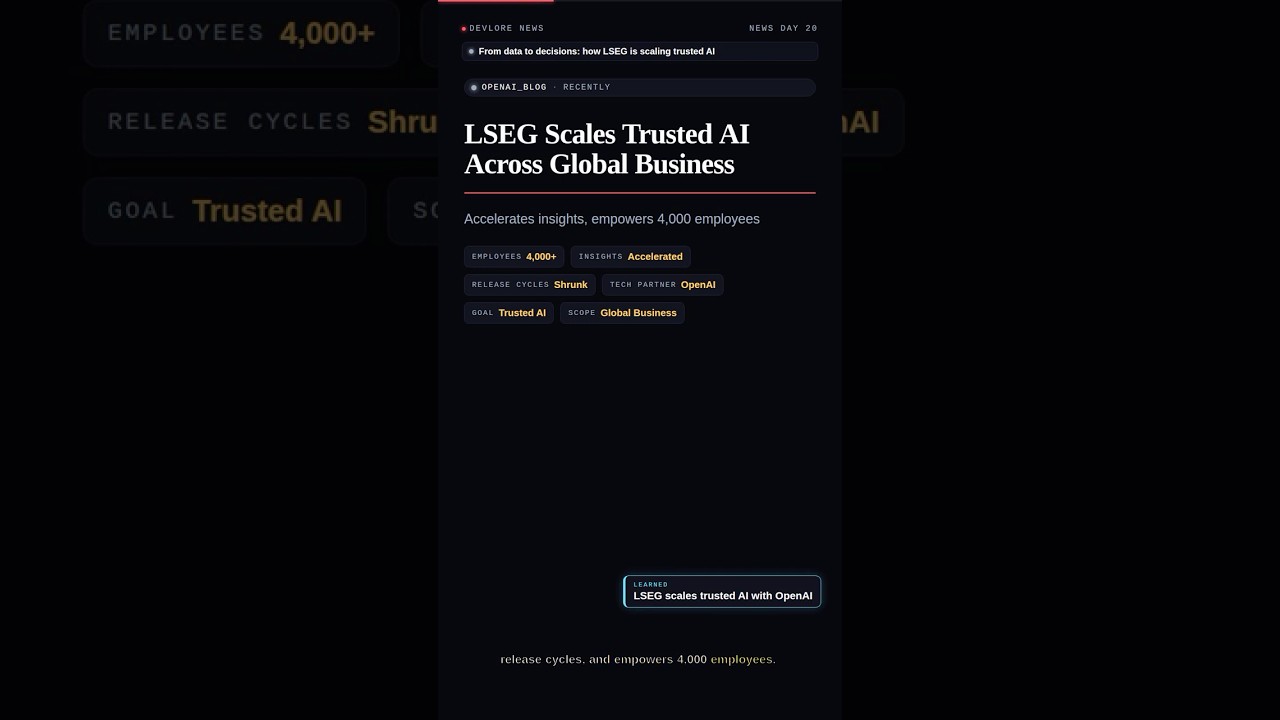
London Stock Exchange Group (LSEG) just announced it's scaling OpenAI's models across its entire global operation. This isn't a pilot — 4,000 employees are now using AI tools to accelerate insights, shrink release cycles from months to weeks, and make faster data-driven decisions. LSEG, a heavyweight in financial data and infrastructure, is embedding GPT-based capabilities into its core workflow. The announcement came via an OpenAI case study, heavy on specifics: automated extraction from unstructured financial documents, real-time risk analysis, and AI-assisted code generation for internal platforms. They're not just toying with chatbots — LSEG is building AI into the plumbing.

Why financial giants are finally betting big on generative AI

Financial services has long been a cautious adopter of AI. Regulatory pressures, data privacy requirements, and the sheer cost of error have made banks and exchanges move slowly. But since GPT-4 dropped, the calculus shifted. LSEG's move fits a broader pattern: Bloomberg built BloombergGPT, JPMorgan has LLM Suite, and Morgan Stanley deployed an OpenAI-powered assistant for advisors. The difference? LSEG is taking it to internal operations, not just client-facing tools. They're using fine-tuned models on proprietary data — think earning reports, regulatory filings, and market feeds. The result: analysts who used to spend days on data extraction now do it in minutes. That's real ROI.

What LSEG's deployment means for enterprise AI adoption

This matters beyond LSEG. When a 300-year-old exchange group ratchets up its AI spend internally, other financial institutions notice. The message is clear: generative AI isn't just for customer support or marketing copy — it's for core business logic. LSEG is reportedly seeing a 40% reduction in release cycle time for internal software. That's not a vanity metric; that's engineers shipping features faster. Of course, there's a catch: they're running these models through Azure OpenAI Service, meaning they've tied their AI stack to Microsoft's cloud. That's a vendor lock-in risk, but for now, the trade-off seems worth it. If I'm a competitor, I'm worried.

The open questions around scale, trust, and regulation

LSEG's story is impressive, but it leaves important questions unanswered. How are they ensuring accuracy in financial decision-making? A hallucinated fact in a loan risk assessment is not a typo — it's a lawsuit. They mention 'trusted AI' but don't detail their validation pipeline. What about regulatory compliance? Financial firms must explain model outputs under MiFID II and other regimes. Black-box models from OpenAI don't exactly scream interpretability. Also, 4,000 employees is a start, but LSEG has 23,000+ staff. Scaling to everyone means dealing with resistance, retraining, and the risk of deskilling. Watch for how they handle failure cases — because there will be some.
Watch video
Video thumbnail
Click to play

Frequently Asked Questions

What exactly is LSEG doing with OpenAI?

LSEG is integrating OpenAI's models (likely GPT-4 variants) into its internal workflows for tasks like extracting data from financial documents, generating code, and analyzing risk. The deployment covers 4,000 employees globally and is designed to speed up decision-making and reduce software release cycles.

Why is LSEG using OpenAI instead of an open-source model?

LSEG likely chose OpenAI for its enterprise-grade safety features, existing integration via Azure, and proven performance on complex language tasks. Open-source models require more in-house expertise for fine-tuning and deployment, which can be a barrier for regulated firms needing guaranteed reliability.

What are the main benefits LSEG reports from using AI?

The company says it has cut release cycles from months to weeks, accelerated extraction of structured data from unstructured documents, and empowered employees to make faster, more informed decisions. The exact ROI hasn't been disclosed, but the reductions suggest significant productivity gains.

What are the risks for a financial firm relying on generative AI?

Key risks include model hallucination, bias in outputs, data privacy breaches if prompts contain sensitive information, and regulatory non-compliance if AI decisions can't be explained. Vendor lock-in with OpenAI/Microsoft is another concern — switching costs could be high if better models emerge elsewhere.

How does this compare to other financial AI deployments?

Bloomberg built its own LLM (BloombergGPT), JPMorgan has an internal AI assistant, and Morgan Stanley uses OpenAI for advisor tools. LSEG's approach is notable because it's deeply embedded in internal operations rather than being just a chat interface. It's also one of the largest documented internal rollouts in finance.

↑ SWIPE FOR NEXT