LIVE
OpenAIOpenAI Previews GPT-5.6 Sol: Next-Gen Coding and Safety·DeepMindDeepMind gives Gemini 3.5 Flash desktop control·Google AIGoogle Finance exits beta with new Android app·HuggingFaceRun vLLM on HuggingFace Jobs with One Command·HuggingFaceNVIDIA NeMo AutoModel Automates Fine-Tuning, Cuts Time by 40%·OpenAIOpenAI research: AI agents extend work beyond simple tasks·HuggingFaceHuggingFace launches CUGA: lightweight harness for agentic apps·OpenAIOmio Uses OpenAI to Build Conversational Travel Experiences·HuggingFacePP-OCRv6 Arrives on Hugging Face: 50 Languages, Tiny to Medium Models·OpenAISamsung equips 100,000+ employees with ChatGPT Enterprise·OpenAIOpenAI Rolls Out Spend Controls and Analytics for ChatGPT Enterprise·HuggingFaceMosaicLeaks Benchmark Exposes Research Agents' Inability to Keep Secrets·Google AIGoogle's AMIE Medical AI Matches Doctors in Disease Management·HuggingFaceMolmoMotion: Language-Guided 3D Motion Forecasting Hits HuggingFace·DeepMindDeepMind and UK government build AI prototype to speed housing decisions·HuggingFaceHugging Face lets you deploy robot policies from Hub to real hardware·OpenAIOpenAI's Deployment Simulation predicts model behavior before launch·Google AIGoogle invests $1.5B in Alabama data center expansion·OpenAIOpenAI launches Partner Network with $150M investment fund·OpenAIOpenAI launches three Agent Academy courses for workplace AI skills·OpenAIOpenAI Previews GPT-5.6 Sol: Next-Gen Coding and Safety·DeepMindDeepMind gives Gemini 3.5 Flash desktop control·Google AIGoogle Finance exits beta with new Android app·HuggingFaceRun vLLM on HuggingFace Jobs with One Command·HuggingFaceNVIDIA NeMo AutoModel Automates Fine-Tuning, Cuts Time by 40%·OpenAIOpenAI research: AI agents extend work beyond simple tasks·HuggingFaceHuggingFace launches CUGA: lightweight harness for agentic apps·OpenAIOmio Uses OpenAI to Build Conversational Travel Experiences·HuggingFacePP-OCRv6 Arrives on Hugging Face: 50 Languages, Tiny to Medium Models·OpenAISamsung equips 100,000+ employees with ChatGPT Enterprise·OpenAIOpenAI Rolls Out Spend Controls and Analytics for ChatGPT Enterprise·HuggingFaceMosaicLeaks Benchmark Exposes Research Agents' Inability to Keep Secrets·Google AIGoogle's AMIE Medical AI Matches Doctors in Disease Management·HuggingFaceMolmoMotion: Language-Guided 3D Motion Forecasting Hits HuggingFace·DeepMindDeepMind and UK government build AI prototype to speed housing decisions·HuggingFaceHugging Face lets you deploy robot policies from Hub to real hardware·OpenAIOpenAI's Deployment Simulation predicts model behavior before launch·Google AIGoogle invests $1.5B in Alabama data center expansion·OpenAIOpenAI launches Partner Network with $150M investment fund·OpenAIOpenAI launches three Agent Academy courses for workplace AI skills·
Back
OpenAI
Product/OpenAI

OpenAI Previews GPT-5.6 Sol: Next-Gen Coding and Safety

O

OpenAI

June 28, 2026

2 MIN

Original source

openai.com — read the full announcement →

The Announcement: GPT-5.6 Sol Emerges with a Safety-First Pitch

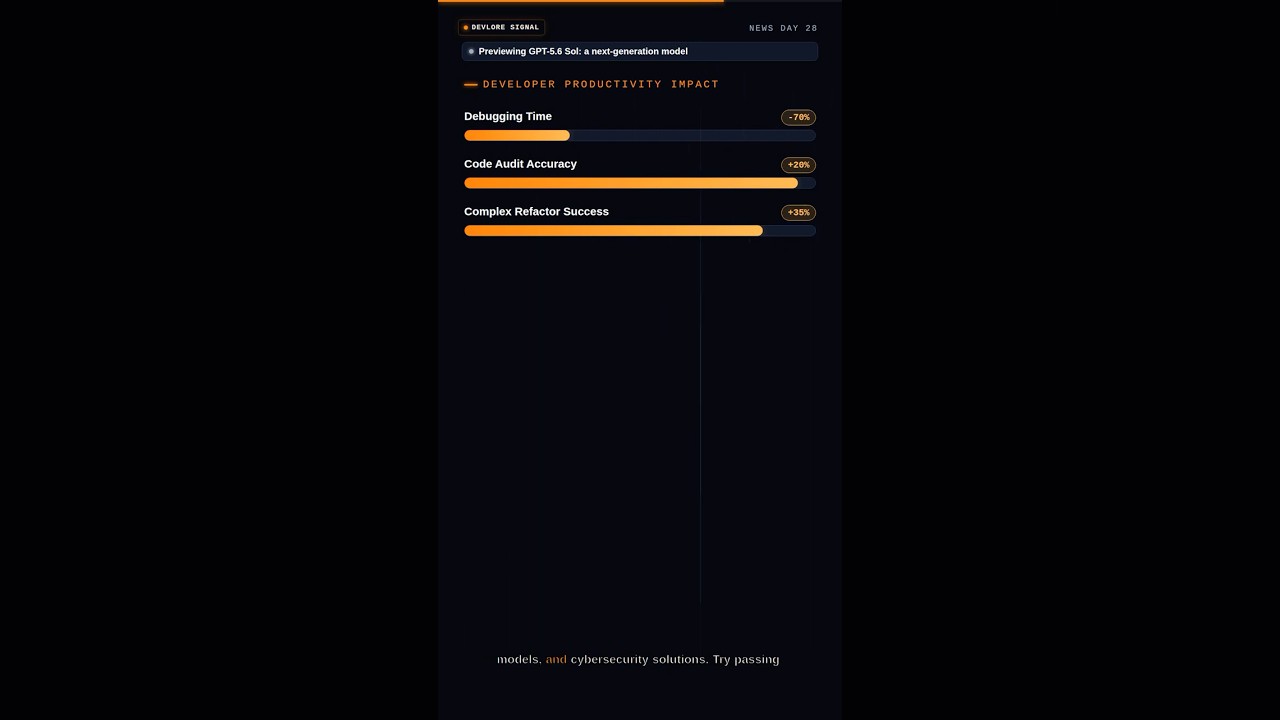
OpenAI has lifted the curtain on GPT-5.6 Sol, its upcoming flagship model, promising significant leaps in coding, scientific reasoning, and cybersecurity defenses. The company frames this as both a capability jump and a safety milestone, pairing the model with what it calls its most advanced safety stack to date. Early benchmarks aren't public yet, but OpenAI claims GPT-5.6 Sol outperforms GPT-4 on key reasoning and code generation tasks — particularly in complex, multi-step problem solving. The cybersecurity angle is new for a preview: OpenAI emphasizes the model's ability to identify and block adversarial prompts more effectively, which could matter a lot for enterprise deployments. For now, it's a preview — no release date, no pricing, just promises and a few technical teasers.

The Context: A Field Moving Faster Than Its Guardrails

Since GPT-4 dropped in early 2023, the landscape has shifted dramatically. Anthropic's Claude 3 Opus, Google's Gemini Ultra, and Meta's Llama 3 have all pushed capability frontiers — but safety has remained a reactive afterthought. We've seen jailbreaks, model theft, and a steady drumbeat of policy failures. OpenAI itself has been criticized for rushing products like GPT-4o without full transparency. That's why the heavy emphasis on GPT-5.6 Sol's safety stack is noteworthy. This isn't just a response to market pressure; it's an acknowledgment that the public's patience with 'move fast and break things' has worn thin. The question, of course, is whether the stack is actually as robust as advertised.

The Implications: Capability Jumps and Trust Deficits

Let's be honest: the most interesting part isn't the model itself — it's that OpenAI is leading with safety. If GPT-5.6 Sol genuinely reduces adversarial vulnerability, it could reshape how enterprises adopt AI for sensitive workloads. Think fraud detection, cybersecurity operations, or scientific simulation where one bad output costs millions. The coding improvements matter too: if the model can reliably debug and refactor across entire codebases, it's not a toy anymore — it's a coworker. But there's a trust deficit. OpenAI has promised safety before and delivered band-aids. This time, they're saying the stack is integral to the model's architecture, not bolted on after training. That's a structural shift. Whether it's enough for regulators and enterprise buyers remains to be seen.

The Unknowns: What OpenAI Isn't Telling Us Yet

Plenty remains under wraps. First, the safety stack details are vague — no specific red-teaming results, no transparency reports, no third-party audits. Second, we don't know the model's parameter count or training data composition, making independent capability assessments impossible. Third, pricing. If GPT-5.6 Sol is locked behind a high API tier or subscription wall, its impact will be limited to well-funded labs and companies. Then there's the competition: Anthropic has its own safety-first pitch with Claude, and Meta is open-sourcing. Will GPT-5.6 Sol be gated or released in any usable way? And finally, release timeline. 'Preview' could mean weeks or months. OpenAI has a history of slipping dates. What to watch: the first independent safety benchmarks, pricing announcements, and whether any competing model ships first with similar safety claims.
Watch video
Video thumbnail
Click to play

Frequently Asked Questions

What is GPT-5.6 Sol?

GPT-5.6 Sol is OpenAI's next-generation large language model, designed to offer improved performance in coding, scientific reasoning, and cybersecurity defense. It was previewed with a focus on an advanced safety stack that the company says is integrated into the model's core architecture.

How does GPT-5.6 Sol compare to GPT-4?

OpenAI claims GPT-5.6 Sol outperforms GPT-4 on key reasoning and code generation tasks, particularly in multi-step problem solving. The model also introduces a new safety stack aimed at reducing adversarial attacks and misuse, which was a weaker point in GPT-4.

What is the safety stack in GPT-5.6 Sol?

The safety stack is a set of integrated components designed to block adversarial prompts, prevent misuse, and ensure alignment during training and inference. OpenAI says it is more advanced than previous versions and is 'baked into' the model, not added after training — though specific technical details have not been released.

When will GPT-5.6 Sol be available?

OpenAI has not announced a release date. The preview is early, and the company says it will share more details in the coming months. Historically, OpenAI previews have led to launches within 6-12 months, but timelines vary.

Will GPT-5.6 Sol be free or open-source?

Given the emphasis on safety and enterprise security, GPT-5.6 Sol is likely to be a commercial product available through OpenAI's API and possibly premium subscriptions. There is no indication it will be open-sourced, and pricing information has not been disclosed.

↑ SWIPE FOR NEXT